Turning down a job offer is uncomfortable, but handled well it can leave the hiring manager with a better impression of you than if you'd said yes. Be prompt, be clear and be gracious. This template works for most situations.
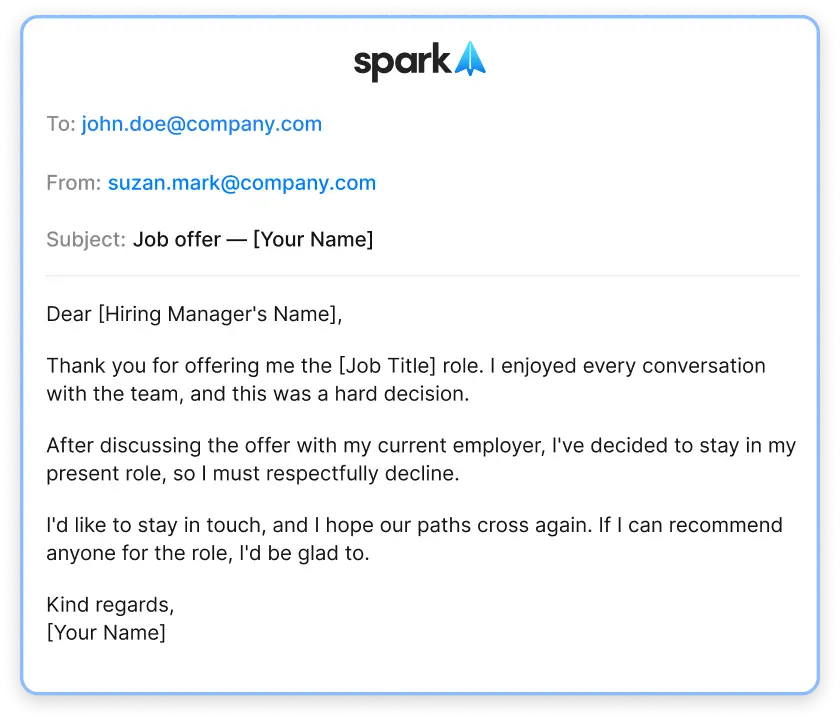
General decline job offer email
Subject: Job offer — [Your Name]
Dear [Hiring Manager's Name],
Thank you for offering me the position of [Job Title] at [Company Name]. I appreciate the time you and the team spent with me during the process.
After careful consideration, I've decided to decline the offer. This wasn't an easy decision, and it reflects my own circumstances rather than anything about the role or the team.
I've enjoyed getting to know [Company Name] and hope our paths cross again.
Kind regards,
[Your Name]
[Phone]
Declining for another offer, salary or timing
You've accepted another offer
Subject: Job offer — [Your Name]
Dear [Hiring Manager's Name],
Thank you for the offer to join [Company Name] as [Job Title].
I wanted to let you know as soon as possible that I've accepted a position elsewhere that's a closer fit for my plans right now. I'm grateful for the time you invested in me, and I was impressed by [specific thing: the team, the product, the interview process].
I'd be glad to stay in touch, and I wish you and the team every success.
Kind regards,
[Your Name]
Compensation doesn't meet your needs
Subject: Job offer — [Your Name]
Dear [Hiring Manager's Name],
Thank you for offering me the [Job Title] role. I'm genuinely enthusiastic about [Company Name] and the work your team is doing.
Having reviewed the offer carefully, I've decided to decline, as the compensation doesn't meet what I need at this stage of my career.
Thank you again for your time, and I hope our paths cross in the future.
Kind regards,
[Your Name]
Short version (after an early-stage or brief process)
Subject: Job offer — [Your Name]
Dear [Hiring Manager's Name],
Thank you for the offer for the [Job Title] position. After some thought, I've decided it isn't the right move for me at this time, so I'll respectfully decline.
I appreciate your time and wish you the best in filling the role.
Kind regards,
[Your Name]
How to decline a job offer by email
- Decide first, then send quickly. Once you're sure, decline within 24–48 hours. The company may have other candidates waiting. If the offer arrived by email, Spark's Auto-Drafts can prepare a first draft of your reply, so you start by editing rather than from a blank page.
- Subject line. Keep it simple and professional — your name and "Job offer" is enough.
- Thank them. Mention the role and the people involved. It's a courtesy that people remember.
- State the decision clearly. Use the word "decline" so there's no ambiguity.
- Give a reason only if it helps. A brief, honest reason is fine (another offer, compensation). Details aren't required.
- Close warmly. Leave room for future contact. Industries are smaller than they look.
Ways to phrase your reason in one line
If you give a reason, one sentence is enough. Pick the one that's true and leave it at that:
- "I've accepted a role that's a closer match for the direction I want to take."
- "After thinking it through, I've decided to stay in my current position."
- "The location doesn't work for my family at the moment."
- "I've decided to focus on [specialism], which this role doesn't include."
- "The compensation isn't where it needs to be for me to make a move at this stage."
If you've been speaking to the hiring manager by phone, consider calling first and following up with this email so the decision is on record. Either channel is acceptable, but a call plus a short email is the most courteous option for senior roles or after a long process.
What to say if you decline by phone
Keep the call to a couple of minutes, then send the email above so the decision is on record. Something like:
"Hi [Name], thank you again for the offer and for everyone's time. I've thought it over carefully, and I've decided not to accept. [One-line reason, if you're giving one.] I really enjoyed meeting the team and I'd like to stay in touch. I'll send a short email today to confirm."
If they ask whether anything would change your mind, answer honestly. If nothing would, say so kindly; if better terms would, that's a negotiation, not a decline.
Declining an offer you've already accepted
It should be rare, but it happens. Tell them as soon as possible, apologize sincerely and keep it brief.
You wouldn't be the first. A Gartner survey reported by SHRM found that half of candidates who accepted an offer between May 2022 and May 2023 later backed out and joined another employer. Recruiters are used to it; what they remember is whether you told them promptly.
Call first if you can, then confirm in writing:
Subject: Update on my acceptance — [Your Name]
Dear [Hiring Manager's Name],
I'm writing with news I wish I didn't have to share. Since accepting the [Job Title] role on [date], my circumstances have changed and I'm no longer able to join [Company Name].
I'm sorry for the inconvenience this causes, especially after the time you and the team have invested. I wanted to let you know as early as possible so you can move forward with other candidates.
If there's any paperwork I need to complete or return, please let me know and I'll take care of it right away.
Sincerely,
[Your Name]
Keeping the door open, or negotiating instead
Say you were impressed by something specific and that you'd like to stay in touch; connecting with the hiring manager on LinkedIn afterwards helps. If pay is the only obstacle and you'd genuinely accept better terms, a salary counter-offer email is a better route than a decline.
Subject lines for declining a job offer
- Job offer — [Your Name]
- [Job Title] offer — [Your Name]
- Thank you for the offer
- Re: [Job Title] offer
- Decision on [Job Title] offer
How not to decline a job offer
The worst way to decline a job offer is not to reply at all; going silent is the one sure way to burn a bridge. Recruiters see it often: Janelle Bieler, speaking to SHRM, described candidates "juggling multiple job offers and interview opportunities at once" who never get back to the employers they've dropped. The next worst is being unclear. "I'm not sure it's right for me" sounds like an opening to negotiate, so say plainly that you're declining. Keep the reasons brief, too, because a paragraph of them invites a debate you don't need to have.
Stay gracious even if the process was poor. The email isn't the place for criticism, so save it for exit feedback if you're asked. Only cite compensation if you'd genuinely accept a better offer, and don't decline until your other offer is in writing and you've accepted it formally. (If you're on the other side and need to turn a candidate down, see how to write a rejection email after an interview.)