It's 4 p.m. on a Thursday. A sales rep is halfway through someone’s recent LinkedIn post — another "Slack vs. email" comparison — when her biggest client's name pops up in her inbox. The email is urgent, the kind that needs input from two teammates before she can respond. Her team lives in Slack. The article she was reading recommends "Slack for internal, email for external.” But how practical is that mantra when the people she needs to loop into this conversation now aren’t external stakeholders, but colleagues?
This is the problem every Slack vs. email article opens up and never fills. The advice assumes you get to pick the channel. For most client-facing professionals, you absolutely don't.
The Slack vs. email debate assumes a control you don't have
The heuristic everyone repeats about internal vs. external frames the choice about when to use Slack vs. email as a choice you get to make: pick the right team communication tool for each of your tasks, optimize your workflow, and train your team on which platform handles what. That works fine if everyone you communicate with sits inside your company.
But if you sell, support, consult, or manage any external relationship, your communication channels are imposed on you. You can't tell a prospect "just Slack me." And even though you can add external members to your Slack organization, many clients don’t want the hassle of an external account and another app. They want to work with their vendors according to their own preferences. So work arrives in your inbox, because that's where clients send it, and no internal policy will change that.
So the real question many organizations face isn’t about which tool is better. It’s about how to manage work that arrives through channels that relationships dictate you use. How do you keep your team in the loop without fragmenting everything?
Who actually lives with this problem
The people stuck in the middle of the Slack vs. email pros and cons debate feel it day to day, outside the neat hypotheticals of LinkedIn articles. They're the people like:
- Sales professionals. Pipeline lives in email; team collaboration lives in Slack.
- Customer support. Tickets land in shared inboxes; coordination happens in Slack channels.
- Consultants and agencies. Clients email deliverables and questions; internal communications bounce around Slack threads.
- Account managers and partnerships leads. External stakeholders write emails; internal alignment happens somewhere else entirely.
If your role involves external people who don't use your team's preferred team communication tool, you already know the cost. You're watching two channels at once, translating between them, and hoping nothing slips through the cracks.
What actually happens when context splits
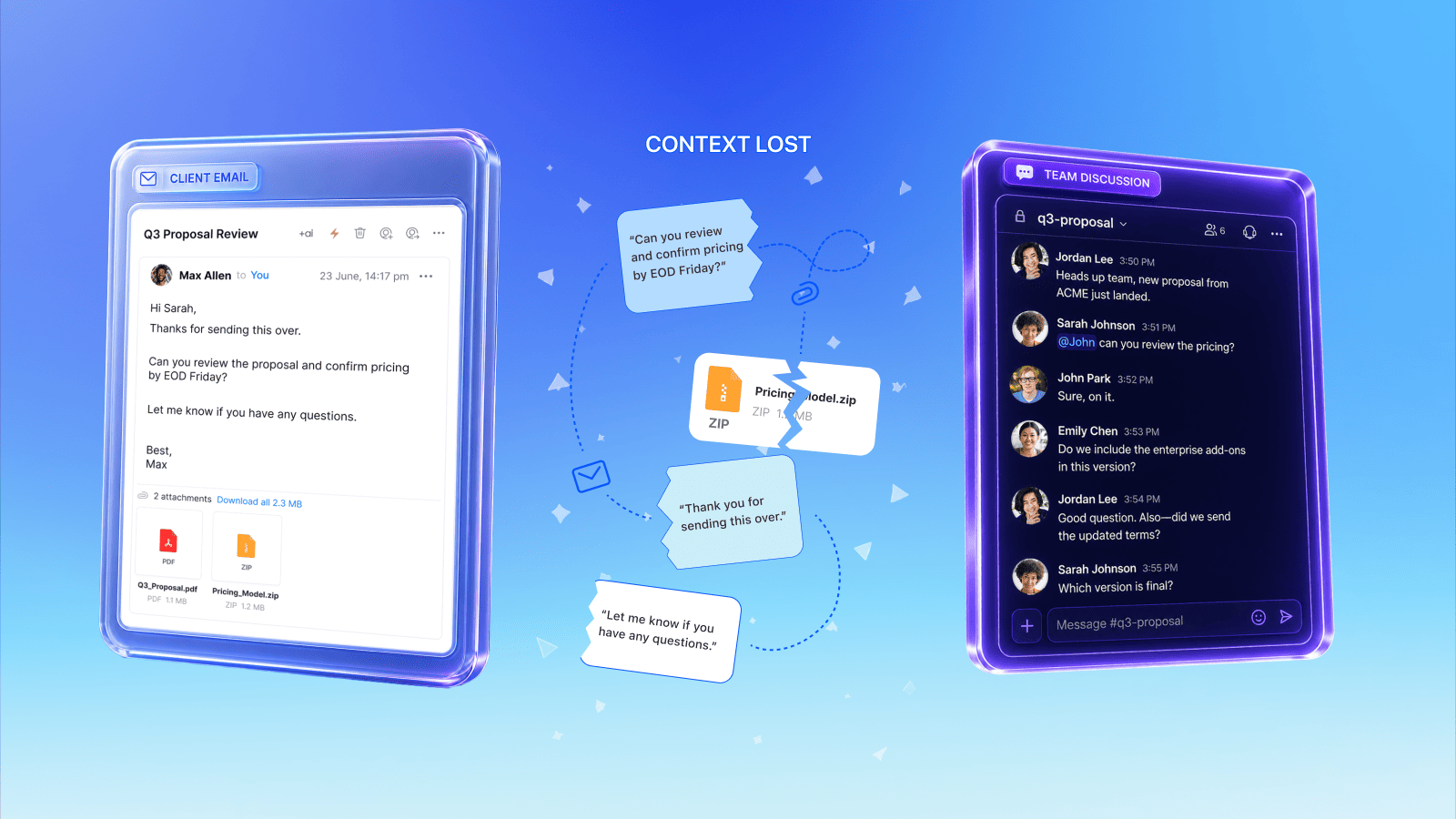
Here's the failure mode that no comparison article describes. A client emails a question. You need input before answering, so you do one of three things:
- Forward the email to three teammates separately. Now there are four reply chains about the same client request.
- Paste a screenshot into Slack. The thread loses headers, attachments, and reply history. Anyone who joins late has no real context.
- Summarize the email in a Slack channel. Your summary smooths over nuance, and the eventual response references a discussion the client can never see.
Then later, someone asks the question every distributed team has heard: "Did anyone respond to that?" Half the team checked email. Half checked Slack. Nobody is sure who saw what, or what got asked. The client follows up because two days have passed.
This isn't a tool problem. It's a context problem. The discussion about the work has been separated from the work itself, and every minute spent stitching the two back together is a minute the client is waiting.
Why the comparison articles miss it
Most Slack vs. email guides treat the question as pure optimization. They line up features, list pros and cons, and recommend you "use both tools well." That advice quietly assumes a closed system where you and your colleagues decide what to use.
In external-facing work, you don't get a closed system. The client picks the channel. Your team picks Slack. Now the burden of bridging the two falls on you, manually, every time. Asking why use Slack instead of email doesn't help when the email is already sitting in your inbox waiting for a reply.
The standard advice — "send shorter emails," "move discussions to Slack," "set communication norms" — doesn't fix this. All of it still leaves you copying content between platforms and praying nothing important gets lost in the move. It’s better to work with your team where the work is happening.
A better question to ask
Rather than creating a false choice between Slack and email, professionals facing these types of situations can better serve themselves by asking:
How do I stay responsive to email — which isn't going away — while collaborating with my team where the work actually lives?
This reframing changes what you look for. Instead of debating when to use Slack vs. email, you start looking for Slack and email integration that keeps team discussion attached to the email itself, not orbiting around it in a separate app.
A few practical principles help:
- Accept email as the client-facing channel. It's not optional. Fighting it wastes energy you could spend responding faster.
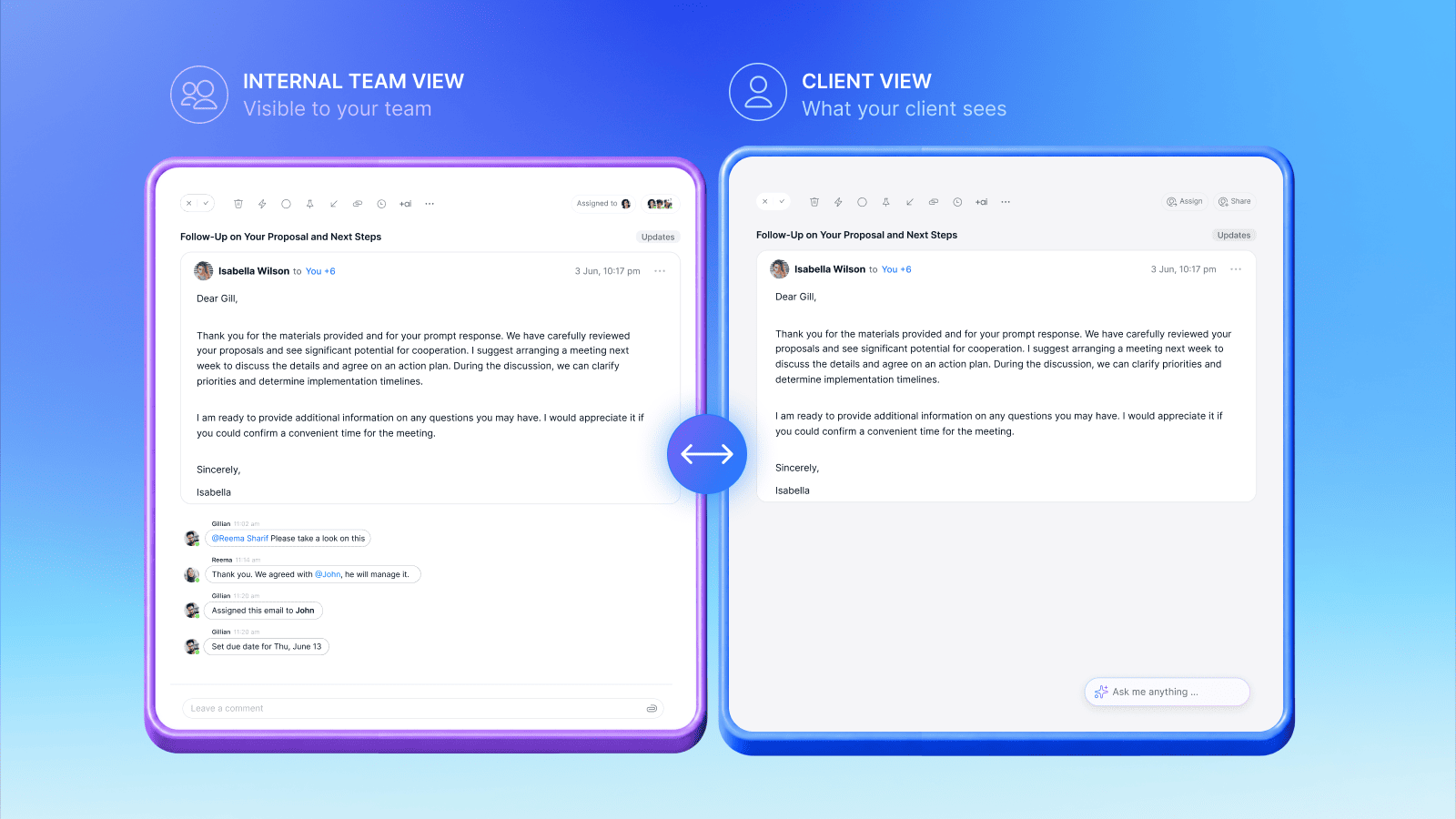
- Keep team discussion in context with the email. When teammates can comment on a client email directly — using @mentions, private notes the client never sees, and a shared view of the conversation — you stop translating between tools. Spark’s Shared Threads make it possible, with your back-and-forth with colleagues kept for internal use, but visible next to the client message, context intact.
- Set clear expectations with your team. Client communication stays in email threads. Internal questions about that communication happen inside those same threads, not in a parallel Slack channel. Tools like Spark for Teams help manage this well.
- Don't drag clients into your stack. If your prospect doesn't want to install another app, that's the end of that conversation. Meet them where they are.
The point isn't picking a winner
The Slack vs. email debate is only relevant if you get to pick. Most professionals dealing with clients, prospects, or external partners have never had that option. The inbox isn't going away for them, and no productivity article is going to argue it out of existence.
The real work is making the unavoidable channel easier to live with — keeping your team's collaboration close to the message, not scattered across a second app. When that connection holds, you can be at peace with whatever tool the client chooses. The right email app keeps context intact, the team aligned, and the client happy. That’s much cleaner than four email reply chains, and a Slack thread could ever manage.
 The Readdle Team