You've cleared your inbox to 20 messages. Your notifications are off, you’ve unsubscribed from all the useless newsletters, and you've spent the last hour responding to anything that needed a real answer. By every measure used in productivity articles, you're winning. So why does your inbox still feel like a heavy burden?
This is the paradox at the center of email overload: the stress doesn't track with the volume. And in a way it makes sense. Email is commonly treated like a quantity problem — too many messages, too many notifications — when the real issue is psychological. So if volume isn't the problem, what is?
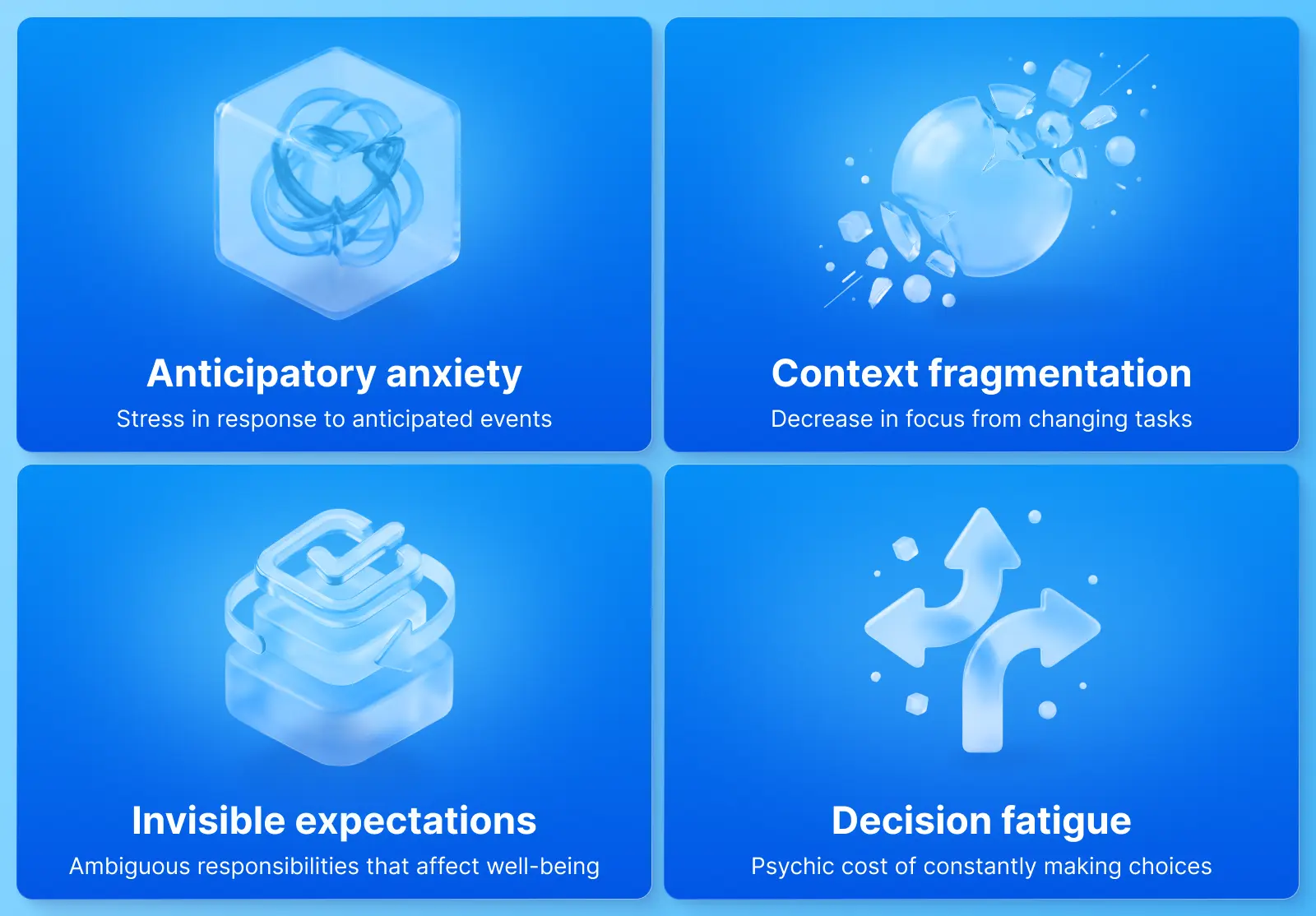
Email overload comes down to four mechanisms, and you can’t fix any of them with an unsubscribe spree or commitments to less frequent inbox checks. Anticipatory anxiety, context fragmentation, invisible expectations, and decision fatigue act on your psychology, creating stress, no matter if you have twenty messages or two hundred. No wonder standard advice never quite works.
Anticipatory anxiety: the stress of knowing you’ll be stressed
Even when you aren't checking email, part of your mind is asking whether you should be. You're at home in the evening, reading a novel on the couch, your phone face-down on the table, fully present — and somewhere underneath that focus, you're wondering whether the client replied, whether your manager sent something urgent, whether a deadline shifted while you weren't looking. The email isn't interrupting you. The possibility of email is.
Studies from researchers at Lehigh University, Virginia Tech, and Colorado State University surfaced this clearly, particularly for people who respond to email after hours.
The expectation of needing to be available creates anxiety independent of actual email received. Your inbox becomes an open psychological loop that never quite closes, because you know (or suspect) important messages are waiting for you and the cost of missing one can be real: a deal, a deadline, a relationship.
What helps here isn't checking less. It's having a system you trust to surface what actually matters, so the wondering can stop. This is part of why Spark's Priority feature works so well. When you know your inbox will alert you to the people and threads that matter, you can leave it alone with confidence instead of vigilance.
Shattered contexts and the cost of switching tasks
The second mechanism is context fragmentation. Gloria Mark's research at UC Irvine put a number on something most people feel intuitively: It takes an average of twenty-three minutes to fully refocus after an interruption like email. A two-minute inbox check isn't a two-minute interruption. It's a two-minute interruption plus the damage to your attention, where part of your mind stays with whatever you just read.
Imagine you’re drafting a report. You glance at your inbox. A colleague needs feedback on a deck, a client hasn't sent the files you asked for, your manager wants to schedule something. You close the email and go back to the report — except now you're also thinking about when to review the deck, whether to nudge the client, what time slots work for the meeting. Your mind’s focus on the report has slipped and getting it back takes longer than you'd think.
The fix here is keeping context together rather than scattering it. When appointments, notes, and communications related to a client live in one place rather than individual calendar, mail, and documentation apps, you don't have to triangulate between tools in order to reconstruct the situation every time you re-engage. Spark's unified inbox, connected calendar, and integrated meeting notes exist for exactly this reason: fewer reconstructions, fewer fragments.
The stress of the expectations piling up in your inbox
Meetings have start times. Calls happen synchronously. Email has neither. That means every message arrives wrapped in a quiet question: how quickly does this need a response? A client emails at seven in the evening. Tonight? Tomorrow morning? Next week? You don't know, so you check. And check again. And feel guilty either way.
Researcher Emma Russell has shown that even conscientious people who practice good email habits like not reacting to every notification experience stress just by hearing the sound of an incoming message. There’s a psychic cost to choosing to delay response, which becomes a stressor in its own right. It compounds because every sender carries different expectations. The newsletter wants nothing from you. The client may want everything. They look identical in your inbox.
The relief here comes from making priorities visible — separating the people and threads that genuinely require attention from the noise that doesn't, and clarifying response norms within your team, like in Spark’s Smart Inbox. You can't always rewrite organizational culture, but you can stop letting every message present itself as equally pressing.
Decision fatigue and the constant pressure to choose
Your email inbox is, in a way, a place where decisions you’ll make accumulate.
Roy Baumeister's research established that judgment draws from a limited daily resource of choice, and email exploits that resource ruthlessly.
- Open your inbox: 43 unread messages.
- Client question — important.
- Team update — maybe important.
- LinkedIn notification — ignore.
- Expense reminder — handle later.
- Meeting confirmation — file.
- Sales pitch — delete.
You haven't replied to anything yet, but you've made 30 micro-decisions, and you're already a little tired.
Frequent email checking correlates with increased stress, and this is a big part of why. Triage isn't free. Each small decision compounds with the next, and the cost shows up later in the day, when the work that actually matters needs your sharpest thinking.
The answer is automatic organization. Every newsletter that gets grouped without your input, every notification routed away from your priority view, is one less decision standing between you and your real work. Spark's automatic grouping of newsletters and notifications was built around this idea: such basic triage shouldn't be the first thing you do every morning.
Managing email anxiety and its psychological load
Most email advice operates on the assumption that the problem is throughput — that if you could just process messages faster, or receive fewer of them, the stress would dissolve. For many people, especially those in sales, client services, or any role where email is the work, this advice is essentially useless. You can't unsubscribe your way out of a job that runs on email.
The shift worth making is from "get through email faster" to "remove the psychological load email creates” by doing things like:
- Reducing anticipatory anxiety by setting up a system like Spark’s priority notifications that alert you when something truly important comes your way.
- Minimizing context fragmentation by keeping related conversations together in Spark’s unified inbox, which keeps context together across email, calendar, and meeting notes.
- Making expectations visible by clarifying what’s urgent and what can wait. Smart Inbox can help, but this also requires conversations with your team (and maybe even clients) about when and how you’ll respond to email.
- Reducing triage decisions by letting Smart Inbox separate important messages sent by humans from newsletters, notifications, and other low-stakes emails. Every message that gets grouped automatically means one less decision you have to make.
Email overload is real. It just isn't about the number of messages. It's about the vigilance, fragmented attention, unclear expectations, and the steady drip of small decisions. If all you’re doing is chasing a clean inbox, you may not be addressing deeper sources of stress. Because inbox zero is a meaningless target if you don’t have inbox calm.
 The Readdle Team