The networking emails that get replies make one small, specific request and make it easy to say yes. "I'd love to pick your brain" doesn't. Here's a template for asking someone you don't know well for 20 minutes of advice. If you just want to say hello with no ask, that's an introduction email instead; see how to introduce yourself in an email.
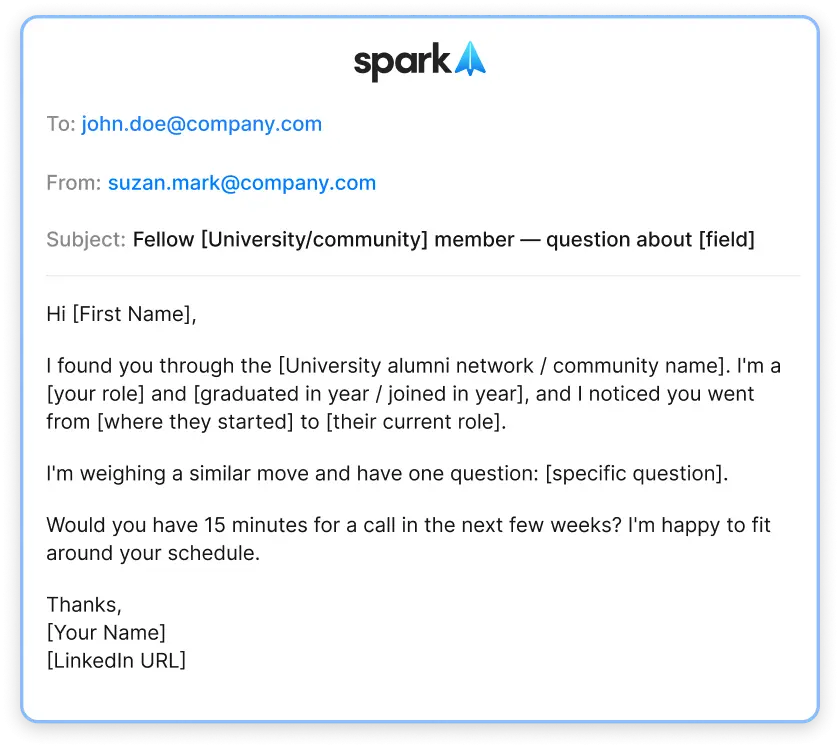
General networking email template
Subject: Question about [their area of expertise]
Hi [First Name],
I'm [Your Name], a [your role] at [Company Name]. I came across your [talk/article/post] on [topic] and [one specific thing you took from it].
I'm currently [your situation: moving into X, building Y, deciding Z], and I'd value your perspective on [one specific question].
Would you be open to a 20-minute call in the next couple of weeks? I'm happy to work around your schedule.
Thanks for considering it,
[Your Name]
[LinkedIn URL]
Networking emails for introductions, reconnecting and events
Asking a mutual contact for an introduction
Subject: Intro to [Target Person]?
Hi [First Name],
I hope things are going well at [their company]. I saw you're connected to [Target Person] at [Target Company].
I'm [reason: exploring a move into X / working on a project in Y], and I think [Target Person]'s experience with [specific thing] would be really useful.
Would you be comfortable introducing us? I've written a short blurb below you can forward, so it's no extra work.
---
[Your Name] is a [role] at [Company Name] who [one-line background]. They'd love 20 minutes to ask about [topic].
---
No pressure at all if it doesn't feel right.
Thanks,
[Your Name]
Reconnecting with an old contact
Subject: It's been a while — [Your Name]
Hi [First Name],
It's been [time] since we [worked together at X / met at Y]. I saw [recent news about them] — congratulations.
I've recently [your update in one line]. I'm now looking at [goal], and your experience with [topic] came to mind.
Would you be up for a quick catch-up call or coffee in the next few weeks?
Best,
[Your Name]
After meeting at an event
Subject: Great to meet you at [Event name]
Hi [First Name],
It was good to meet you at [Event name] on [day]. I enjoyed our conversation about [topic].
As promised, here's [the article/resource/contact you mentioned]: [link].
I'd like to continue the conversation about [topic]. Would you have 20 minutes for a call in the next week or two?
Best regards,
[Your Name]
How to write a networking email to someone you don't know
- Subject line. Specific and low-pressure. Their topic or a shared connection works better than "Networking opportunity."
- Who you are, in one line. Role and company. Your full background can wait.
- Why them. Show you know their work. One genuine, specific reference.
- The ask. One question, one time-boxed request (20 minutes), or one introduction.
- Make it easy. Offer to work around their schedule or include a forwardable blurb.
- Follow up once. If there's no reply after a week, one short follow-up is fine. Then let it go.
If sending a request like this feels awkward, the odds are better than you'd guess. In studies by Stanford's Francis Flynn and Columbia's Vanessa Lake, people expected to need about 50% more askers than it actually took to get a yes. As Flynn put it, "People are more willing to help than you think."
Networking email subject lines
- Question about [their expertise]
- [Mutual contact] suggested I reach out
- Intro to [Target Person]?
- Great to meet you at [Event name]
- It's been a while — [Your Name]
- 20 minutes on [topic]?
- Advice on moving into [field]
Why networking emails go unanswered
Networking emails usually fail because the ask is either too vague or too big. "Can I pick your brain?" puts the work on the other person, so ask one specific question instead. Don't ask for a job in a first email either. Ask for advice, because opportunities follow conversations; if you do want to apply, an unsolicited application email is the better format.
Keep it brief and genuine. Keep the email under 150 words, and swap flattery for substance: "I'm a huge fan" means less than one specific reference to their work. Once you've had the conversation, send a short thank-you note after the call. That's what turns one conversation into a relationship.
If you send networking emails regularly, save your best version as a template in Spark and adjust the details each time.When someone says yes to a call, Auto-Drafts drafts the reply to lock in a time, so the conversation doesn't stall.