Outreach is asking someone to collaborate with you — feature your work, share an audience, build something together. Like a cold email, it's unsolicited, but a cold email usually aims to sell, while outreach proposes something that benefits both sides. It works when the benefit to them is obvious from the first two lines. Here's a template for a partnership pitch, followed by versions for press, podcasts and guest content.
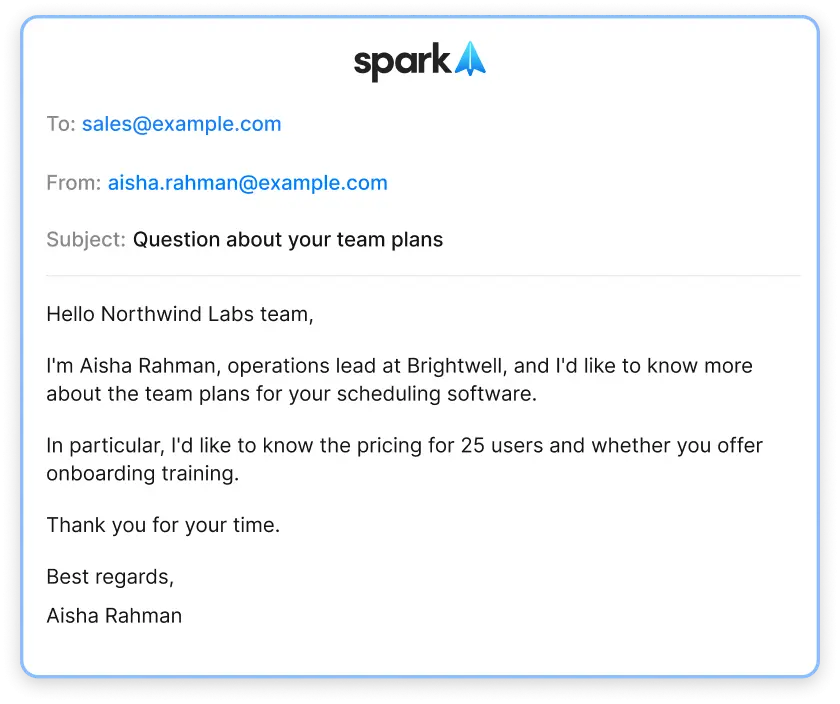
Partnership outreach email template
Subject: Partnership idea: [Their Company] × [Company Name]
Hi [First Name],
I'm [Your Name], [role] at [Company Name]. We [what you do, in one line], and our [audience size/type] overlaps closely with yours.
I have an idea I think would work for both of us: [one-sentence proposal, e.g., a co-hosted webinar on X / a joint guide to Y].
For you, that means [specific benefit: reach, content, revenue]. On our side, we'd handle [what you'd take on].
Would you be open to a 20-minute call to explore it? I can send a one-page outline first if that's easier.
Best,
[Your Name]
[Company Name] · [website]
Outreach templates for press, podcasts and guest articles
Press / journalist pitch
Subject: Story idea: [specific angle in 6–8 words]
Hi [First Name],
I read your piece on [recent article] — [one specific reaction]. I have a related story your readers may be interested in.
[Two sentences: the news or data, and why it matters now.]
I can share [data, a customer interview, an expert comment] and am available for a call this week.
Thanks,
[Your Name]
[Title], [Company Name] · [phone]
Podcast guest pitch
Subject: Guest idea for [Podcast name]: [topic]
Hi [First Name],
I've been listening to [Podcast name] since [episode or time] — the episode with [guest] on [topic] was especially useful.
I'm [Your Name], [role] at [Company Name]. I'd love to talk with your listeners about [topic], including:
- [Talking point 1]
- [Talking point 2]
- [Talking point 3]
Previous interviews: [link]. Happy to work around your recording schedule.
Best,
[Your Name]
Guest article or content collaboration
Subject: Article idea for [Publication/Blog]: [working title]
Hi [First Name],
I'm [Your Name], [role] at [Company Name]. I've noticed [Publication] covers [topic] regularly, and I have an article idea that would fit:
"[Working title]" — [one-line summary of the angle and what readers get].
It would be original and exclusive to you. Samples of my writing: [link 1], [link 2].
Would this be of interest?
Thanks,
[Your Name]
Writing an outreach email, step by step
- Research first. Read their recent work. Your opening line should prove you did. Find a named contact through the company's team page, LinkedIn or the publication's masthead; a named person beats a generic inbox.
- Subject line. Name the idea, not yourself: "Partnership idea" or "Story idea" plus the specific angle.
- Who you are. One line — see how to introduce yourself in an email for wording. Credibility comes from the idea, not your biography.
- The proposal. One sentence. If it takes a paragraph, it isn't clear yet. Keep the whole email under 150 words; press pitches can run slightly longer if you're sharing data.
- What's in it for them. Be concrete: an audience, an exclusive, useful content, revenue.
- An easy next step. A short call, or an offer to send a brief outline.
- Follow up once or twice. Three to five business days apart, each adding something new.
Outreach email subject lines
- Partnership idea: [Their Company] × [Company Name]
- Story idea: [specific angle]
- Guest idea for [Podcast name]: [topic]
- Article idea for [Publication]: [working title]
- Exclusive data on [topic] for [Publication]
- Co-hosting a [webinar/event] on [topic]?
Why outreach emails get ignored
Outreach fails when it's about you rather than them. Lead with what they get, not what you want, and match their audience: a podcast about leadership doesn't want your product launch. Editors and partners can also tell when a pitch has gone to fifty people, so write fewer, better emails.
Keep the first ask small. Start with a call or an outline, not a signed agreement or a full article draft, and link to samples rather than attaching them; unknown attachments often go unopened or get caught by a spam filter. Finally, plan for silence. Many replies come after the follow-up, not the first email.
The numbers make the case for planning one in. In Backlinko and Pitchbox's study of 12 million outreach emails, most pitches went unanswered, with only 8.5% getting a reply, and adding a single follow-up lifted replies by 65.8%.
If you're pitching many partners or publications, Spark's AI Assistant can draft a tailored first version for each, so you start from something specific instead of a blank page and when an editor or partner replies, Auto-Drafts has your response drafted in your voice, ready to review.