Email marketing remains a vital tool in the digital marketer's toolkit, but its success depends partly on timing. While crafting a compelling message is crucial, knowing the best time to send emails can measurably enhance your campaign's effectiveness. With varying advice and theories circulating, we've pulled together the latest studies, covering more than 30 billion emails, to provide you with evidence-backed insights into the best time to send an email for maximum engagement.
Quick answer: What is the best time to send an email?
For opens, 9–11 AM in your recipient's time zone is the most reliable window across large studies. For replies to work emails, 8 AM to noon performs best. For clicks and sales, test mid-afternoon and evening sends too.
- Best time for opens: 9–11 AM in your recipient's time zone (Omnisend, 2026).
- Best day for opens: Tuesday, with a 31.27% average open rate (Omnisend, 2026).
- Best time for clicks: mornings (7–8 AM) and 4 PM in Omnisend's data; 8–9 PM in MailerLite's.
- Best time for replies to business or cold emails: 8 AM to noon on Wednesday or Thursday (Belkins, 2025 data).
The best time to send email: what data tells us
The digital era has provided us with vast datasets to analyze and understand user behavior. The best time to send an email can differ based on your audience's demographics, habits, and time zones. So while there is no definitive one-size-fits-all answer, a consistent pattern emerges when we look at the best time to send emails:
For opens, 9–11 AM is the most reliable window. Omnisend's 2026 analysis of about 26 billion emails found it the strongest slot across the week, and MailerLite's data puts most weekday open peaks between 8 and 11 AM.
For B2B emails, sending between Tuesday and Thursday, in the morning (8 AM to noon), often yields the best results. In Belkins' study of 7.5 million cold emails, Wednesday and Thursday tied for the highest reply rate, and morning sends beat every other time slot.
For B2C emails, especially those targeting consumers who check their email in the evenings, a slot between 7 PM and 9 PM might work better. MailerLite's data supports this: on most days, click rates peak between 8 and 9 PM, even though opens peak in the morning.
During a typical workday, many users check email when they arrive at work, but the influx of morning tasks often means they skim it or save it for later. As lunchtime approaches, there's a shift in focus. People take breaks and are more likely to engage with non-work-related content – making it a strategic window for sending emails. Omnisend's data shows a midday buying window too: on Tuesday, 12 PM had the highest conversion rate of any midday slot (0.131%).
Different industries also witness varying peak times. For retail, weekends can see a surge in engagement as consumers engage in shopping activities. In contrast, weekdays, particularly mid-week, are optimal for professional services where emails are checked during business hours.
MailerLite's industry data shows how wide the spread is:
- E-commerce: Tuesday at 4 PM had the week's highest click rate (7.57%).
- Creators: Monday at 9 PM had the week's highest click rate (9.01%).
- Institutions (education, government, non-profits): Friday at 8 AM had the highest click rate in the whole study (12.26%).
- Entrepreneurs and SMBs: Thursday at 9 AM had the week's highest open rate (46.3%).
The best day of the week to send emails
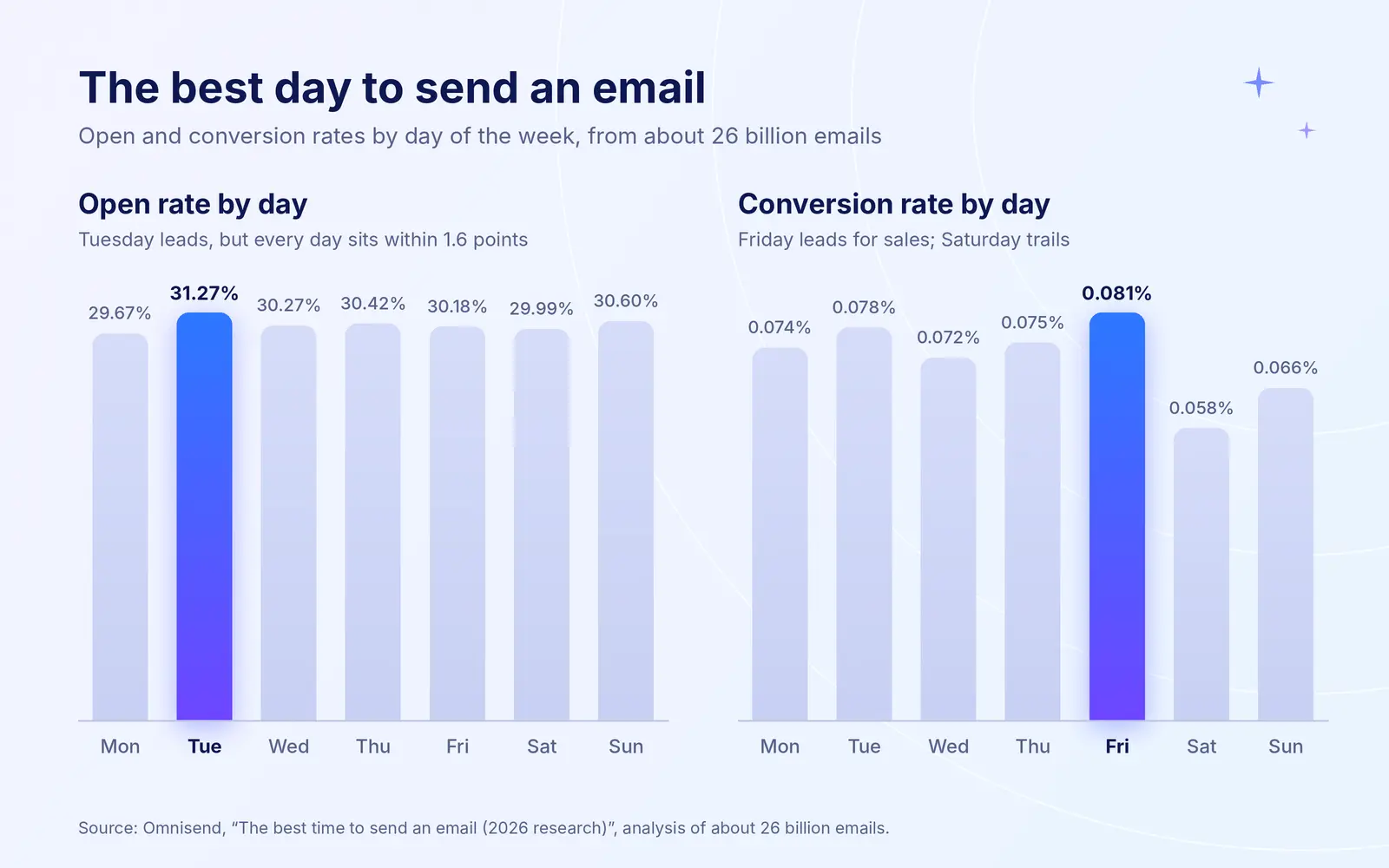
Tuesday leads for opens and clicks, and Friday leads for sales. Omnisend's 2026 study found the gap between the best and worst day for opens is only about 1.6 percentage points, so pick your day based on what you want the reader to do. For cold and business emails, Wednesday and Thursday earned the most replies in Belkins' 2025 data.
| Day | Open rate | Click-to-sent rate | Conversion rate |
| Monday | 29.67% | 0.75% | 0.074% |
| Tuesday | 31.27% | 0.81% | 0.078% |
| Wednesday | 30.27% | 0.79% | 0.072% |
| Thursday | 30.42% | 0.78% | 0.075% |
| Friday | 30.18% | 0.77% | 0.081% |
| Saturday | 29.99% | 0.68% | 0.058% |
| Sunday | 30.60% | 0.69% | 0.066% |
Source: Omnisend, 2026, about 26 billion emails.
MailerLite's data points the same way on how close the days are: average open rates sat between roughly 46.5% and 47.5% on every day of the week. Marketers send the most campaigns on Thursday, Friday and Wednesday, so those inboxes are the most crowded.
The best time to send an email on each day
The best hour changes with your goal. Here's what Omnisend's 2026 data shows for opens, clicks and conversions, with MailerLite's peak open time for comparison.
Best time to send an email on Monday
Omnisend: 1 PM for opens (32.68%), 4 PM for clicks, 8 AM for conversions (0.114%).
MailerLite: opens peak at 10 AM (49.4%) and stay high until 1 PM.
Best time to send an email on Tuesday
Omnisend: 7 AM for opens (33.41%), 8 AM for clicks (0.94%), 12 PM for conversions (0.131%).
MailerLite: opens peak at 10 AM (48.7%).
Best time to send an email on Wednesday
Omnisend: 9 AM for opens (32.12%), 4 PM for clicks (1.08%, the highest click rate of any hour in the study), 1 PM for conversions.
MailerLite: opens peak at 11 AM (48.5%).
Best time to send an email on Thursday
Omnisend: 2 PM for opens (33.06%), 8 AM for clicks, 10 AM for conversions.
MailerLite: opens peak at 9 AM.
Best time to send an email on Friday
Omnisend: 9 AM for opens (31.92%), 4 PM for clicks, 7 AM for conversions (0.138%, the single best hour for sales in the study).
MailerLite: Friday is the only day where opens peak in the evening, at 6 PM (49.7%), which is also the week's highest click rate (8.09%).
Best time to send an email on Saturday
Omnisend: 9 AM for opens (33.19%), but Saturday has the week's lowest click and conversion rates.
MailerLite: opens peak at 9 AM (48.9%). Better for newsletters and softer content than sales.
Best time to send an email on Sunday
Omnisend: 11 AM for opens (33.69%, one of the strongest of the week) and 12 PM for conversions (0.109%).
MailerLite: opens peak at 9 AM (48.9%). Fewer senders on Sunday means less competition in the inbox.
Should I send emails on weekends?
For sales emails, usually not: Saturday had the week's lowest click and conversion rates in Omnisend's data. But Sunday late morning had some of the week's best open rates, so weekends can suit newsletters and content.
Opens vs. clicks: why the best time depends on your goal
The biggest change in recent data is that the best time to get an email opened is often not the best time to get it acted on. MailerLite found weekday opens peak between 8 and 11 AM, while clicks peak between 8 and 9 PM. Omnisend's clicks peak earlier, at 7–8 AM and 4 PM, and its conversions peak before noon. The studies disagree on clicks because their senders and audiences differ: Omnisend's customers are mostly online stores, while MailerLite's include many creators and small businesses.
The practical rule: send in the morning when visibility matters (announcements, newsletters, updates) and test afternoon or evening sends when you need a click or a purchase.
Is it better to send emails in the morning or the evening?
Morning, if you want the email seen or answered. MailerLite found opens peak between 8 and 11 AM and Belkins found morning sends get the most replies. Evening can work for consumer emails, where MailerLite saw clicks peak between 8 and 9 PM.
The best time to send a cold or business email
One-to-one work emails behave differently from marketing campaigns, because what counts is a reply, not an open. Belkins' 2026 study of 7.5 million cold B2B emails sent in 2025 found:
- Emails sent between 8 AM and noon earned the highest reply rate (0.54%), with 5–8 AM close behind (0.52%).
- Late-evening sends (8–11 PM) fell to last place (0.40%), reversing Belkins' earlier studies, where evenings won.
- Wednesday and Thursday tied as the best weekdays (0.48% each). Friday dropped off, and Monday sat mid-table despite the highest volume.
- Founders and owners replied more than any other group (0.57%), ahead of C-level executives (0.42%).
Those reply rates are low because Belkins divides by every email sent, not just opened ones, and because unsolicited email to strangers rarely gets answered. For emails to people you already know, the same timing logic applies: arrive when they're working through their inbox, not at the bottom of an overnight pile. For more on writing the email itself, see our guide on how to email busy people.
You don't have to be at your desk at 8 AM in someone else's time zone to do this. Write the email whenever suits you and schedule it with Send Later in Spark, then set a follow-up reminder in case they don't reply. Spark's Reminder to Follow-up feature brings the email back to your inbox if no reply arrives by the time you set.
How quickly do people open emails?
Timing matters because most engagement happens fast. GetResponse's analysis of 5.5 billion emails (sent July 2019 to June 2020) found:
- 21.5% of opens happened in the first hour after sending.
- Half of all opens (50.6%) happened within six hours.
- 73% of opens happened within 24 hours.
- Clicks came even faster: 33.6% in the first hour and 81% within 24 hours.
If an email lands while your reader is busy, it slides down the inbox, and each hour lowers the chance it gets opened at all.
A caveat: open rates aren't what they used to be
Since 2021, Apple's Mail Privacy Protection has loaded tracking pixels automatically, which counts emails as "opened" whether or not anyone read them. Apple's mail apps now account for about 62% of tracked opens, according to Litmus's July 2026 data. That makes open rates less reliable than they once were, which is why MailerLite recommends testing send times by click rate rather than open rate. Read more about how email tracking works and where its data falls short.
Frequency and consistency in sending emails
While timing is important, so is consistency. Establishing a predictable schedule helps your audience anticipate your emails, which can improve open rates. Sending weekly or bi-monthly at a regular time helps build this expectation.
When is the best time to send a newsletter?
Tuesday to Thursday mornings are a good default for a newsletter, since they combine high open rates with readers who are working through their inbox. Weekend mornings also see strong opens, with less competition. Many email apps now file newsletters separately from personal email (Spark's Smart Inbox is one example), so sending at a regular time helps readers know when to look for yours.
Segmentation and A/B Testing
Segmentation is another crucial factor. Dividing your audience based on their engagement patterns and testing various sending times (A/B testing) can reveal more nuanced insights into the best time to send emails to different segments. Keep each test simple: change only the send time, keep the email and audience the same, and repeat it across three to five campaigns before deciding. Reviewing your last 10–15 campaigns for the days and hours that won most often is a good place to start.
Perfecting the send time of your email campaigns is a subtle art. While 9–11 AM is the safest starting point for opens, the key is understanding your audience and being willing to adapt your strategy based on their habits. Stay informed with the latest data, keep testing, and adjust your approach for the best possible engagement rates. By doing so, you ensure that when the question arises - when is the best time to send an email - you'll have the answer that fits your audience perfectly.